Choosing the Correct LED Display - Viewing Distance versus Pitch
Did you ever look extra closely at a newspaper image? Using a magnifying glass, a photo in a newspaper appears as a series of dots, and indeed that is all they are. The image is only an illusion between the ink on the paper and the amount of light that is reflected through the area of the image showing up as shadow and light.
These dots are similar to the illusion of clusters of diodes (pixels) in an LED sign. The closer the pixels are to each other (pitch) the finer the image appears (resolution). Just as you would not read a newspaper using a high-powered magnifying glass that translated the images as clusters of dots, so too is it important to choose the correct LED display pitch for the intended audience viewing distance.
If the pitch is too high (25 millimeters apart from diode to diode, for example) and you are very close to the display, the images will be difficult to distinguish. They would look pixilated or grainy. It is therefore important to choose the correct pitch for the correct viewing distance.
For example, you walk into a restaurant, and there are people in front of you waiting to place their order. You see from a distance a menu that is sharp and easy to read. The letters and numbers and symbols are crisp and sharp, and as you get closer and closer to the sign, you can begin to see the display for what it truly is: pixels separated by space.
Chances are the LED signs inside restaurants have a low pitch (5 millimeters (mm) to 8mm, perhaps) meaning that the diodes are grouped very close together at only 5mm to 8mm apart from their centers; a very high resolution. Even though high resolution is desirable, the effect can be achieved in different circumstances with much more cost-effective applications. As you can imagine, the more diodes built into the sign, the more expensive the price.
In many outdoor LED displays that are used on or near street level such as telephone kiosks, subway displays, or retail billboards, a pitch of 8mm to 12mm is used.
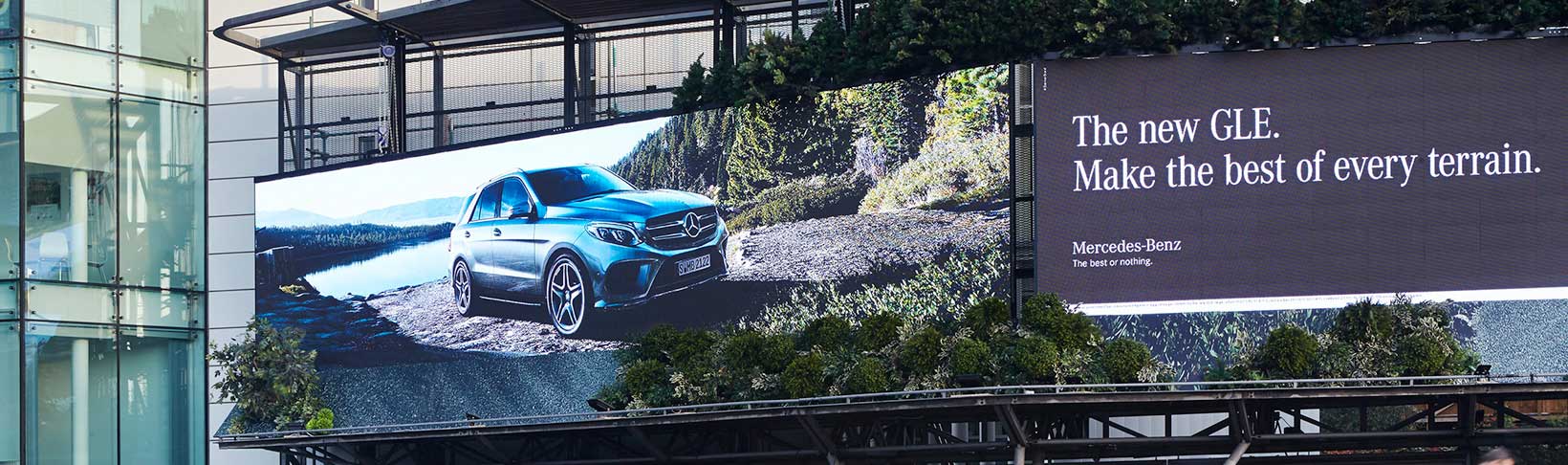
Driving on a highway, the driver only has a few seconds in most cases to view, read, and comprehend the LED sign, and usually from great distances. In this scenario, the pitch can be greater (more space between the pixels), and not affect the quality of the signs value. The viewing distance from the sign in effect, compresses the distance of space between the pixels and the illusion is created of pixels closer together than they actually are.
It is, therefore, unnecessary to have a massive billboard with a pitch of 12 millimeters when that high of resolution is lost in the distance of the driver in a car traveling 55 miles per hour. The human eye could never distinguish that fine of detail, especially at that brief moment. The more sensible purchase would be for a sign with a pitch of 16mm to 25mm depending again on the distance and angle of direction that the drivers are expected to view the sign at.
RULES OF THUMB:
VIEWING DISTANCE
- Minimum 1 inch tall character per 50 feet distance
- Character: 8 pixels tall; 6 pixels wide
TYPE OF CONTENT (TEXT, ANIMATIONS, VIDEO)
- Text: 8 pixels tall per line of text
- Animations: 48 pixels tall x 64 pixels wide
- Video: 144 pixels high X 256 pixels wide (16:9 or 1.78)
144 pixels high x 192 pixels wide (4:3 or 1.33)
Understanding the viewing distance, time, angle, and pitch of the sign will help you determine the correct configuration for your particular needs. If you have questions about the correct LED display, billboard, sign, or scoreboard that you want, talk to the experts at Billboard Media Group.
About Ultravision LED: William Y. Hall is President of the privately owned company based in Addison, Texas with offices in China. Ultravision LED specializes in turnkey LED display integration from the LED display, to installation, service, maintenance and even affordable factory financing. Ultravision LED's technological advancements continue to transcend digital communications systems for wide-reaching industries including sports and entertainment, retail, urban spectaculars and digital advertising companies. Information about Ultravision LED and turnkey integrated solutions for schools, retail and advertising applications can be found at www.ultravisionled.com or by calling 214-260-4500.
Ultravision LED displays are manufactured under strict specifications and quality controls. Ultravision LED utilizes a 10-step quality control process before any product is shipped from China. All of the final inspection and assembly is completed in the United States. Ultravision LED also stands behind all of the warranty and maintenance for the LED display.